SEO gets your page ranked in Google's list of links. AEO (answer engine optimization) gets your text used as the direct answer, in places like Google's AI Overviews, featured snippets and voice assistants. GEO (generative engine optimization) gets your brand named and linked inside answers from ChatGPT, Claude, Perplexity and Gemini. Most of the work is the same: pages that answer one question clearly, with facts you own. What differs is where you show up and how you measure it, and on our own site the Google results and the ChatGPT results barely overlapped.
By Yaniv Mizrahi, founder of TalkGenAI. Data from our site 4MeNearMe.com (Search Console and Google Analytics 4, pulled 10 October 2026) and a 40-question test we ran for a client in August 2026, anonymized.
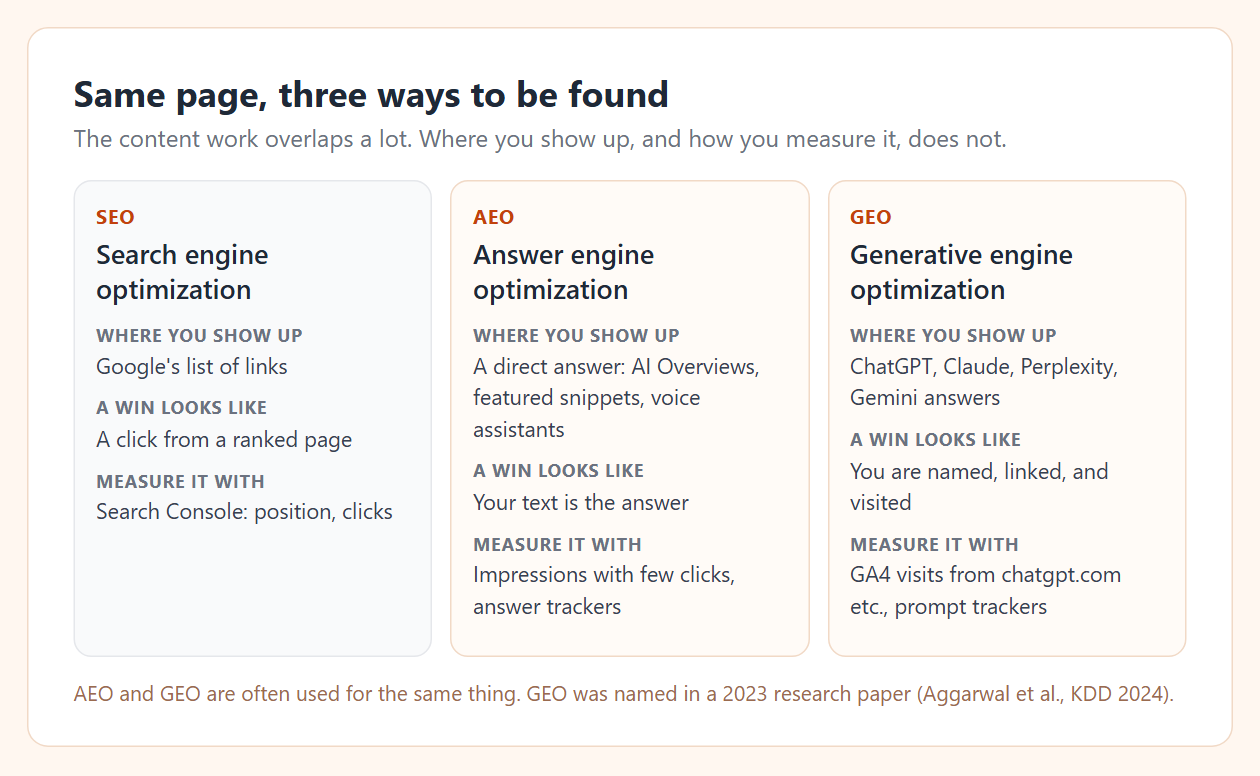
What do SEO, AEO and GEO mean?
| Term | Short for | The goal | Where it shows |
|---|---|---|---|
| SEO | Search engine optimization | Rank your page high in a search engine's results | Google and Bing result pages |
| AEO | Answer engine optimization | Be the answer itself, often with no click | AI Overviews, featured snippets, voice assistants, AI chat |
| GEO | Generative engine optimization | Be a source an AI answer names, quotes or links | ChatGPT, Claude, Perplexity, Gemini, Copilot |
AEO and GEO overlap so much that many people use them for the same thing. A useful way to separate them: AEO asks "is my text the answer?", GEO asks "does the AI point people to me?". The name GEO comes from a 2023 research paper by Aggarwal and colleagues (published at KDD 2024), which reported that changing how content is written can raise its visibility in AI answers by up to 40% on their test set of questions.
What is the same in SEO and GEO?
Most of the work. A page that does well in both:
- Answers the question in its first sentences. Google's snippets and AI answers both quote the part that answers.
- Covers one topic per page. A page about everything is cited for nothing.
- Has facts nobody else has: your prices, your test results, your process, your numbers with a date.
- Can be read without JavaScript. AI crawlers such as GPTBot, ClaudeBot and PerplexityBot read the HTML your server sends and do not run scripts. If your article is built in the browser, they see an empty page.
- Does not block AI crawlers. Check your robots.txt and your CDN. We found Cloudflare's managed robots.txt adding
Disallow: /for GPTBot and ClaudeBot on our own app, on a product whose pitch is being cited by AI. Nobody had turned it on knowingly. - Is indexed by Bing as well as Google. ChatGPT search draws on Bing's index, so verify your site in Bing Webmaster Tools too.
What is different?
| SEO | GEO | |
|---|---|---|
| Who reads your page | A person, after clicking | A model, before answering |
| What counts as a win | Position and clicks | Being named, linked and visited |
| What is shown | Your title and a snippet | A summary that may or may not mention you |
| How it is measured | Search Console | Analytics (AI visits) and prompt trackers (mentions) |
| How stable it is | Rankings move over weeks | The same question can get a different answer each time |
| Typical share of traffic today | Most of your search traffic | 0.1% to 1% on the three sites we can measure |
What does real data say about Google vs AI assistants?
Two findings changed how we work.
Ranking on Google did not predict ChatGPT visits. On 4MeNearMe.com, the page with the most Google impressions (41,356) also got almost all ChatGPT visits (114 of 122 in September). The next four pages by impressions, with 3,906 to 9,404 impressions each, got zero. Only 2 of 37 pages with data got any AI visits at all. The full page table is in our LLM SEO guide.
Being named did not mean being linked. We asked ChatGPT and Claude 40 buyer questions about one client's market.
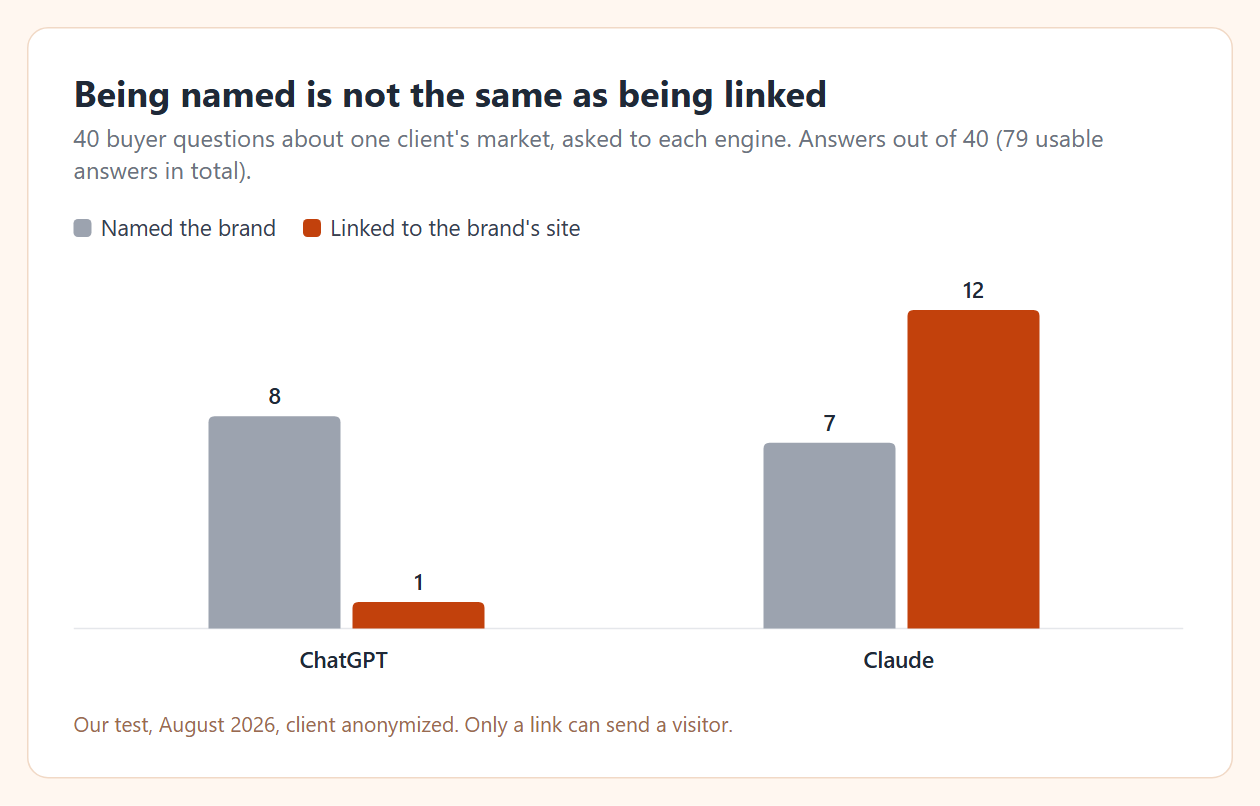
ChatGPT talked about the brand but almost never linked it. Claude linked more often than it named. On the same client, 9 pages were cited by an AI assistant without ranking on Google, and 11 pages were fetched by an AI crawler but never cited. So a Google rank report does not tell you your AI visibility, and a mention score does not tell you your AI traffic.
Which one should I work on first?
Do not split your team in two. Run one content process and measure two ways:
- You already get Google traffic: keep doing SEO. Add AI-visit tracking per page (free in GA4, steps below), find the pages that get both, and write more like them.
- You get almost no traffic: start with SEO basics and pages built on facts you own. The page that won on ChatGPT for us was also our biggest Google page; assistants search the web to find sources, so being findable still matters.
- Buyers ask AI before they search: add a monthly check of what AI says about you for 20 to 50 real buyer questions. Our LLM SEO tools comparison covers which trackers do this and what they cost.
If you sell software, our SEO for SaaS guide shows how we picked which pages to write in the first place.
How do I measure GEO and SEO side by side?
- SEO: Search Console, Performance report: clicks, impressions and position per page.
- GEO visits: in Google Analytics 4, open Traffic acquisition, use Session source as the dimension, and look for chatgpt.com, perplexity.ai, claude.ai, gemini.google.com and copilot.microsoft.com. Add Landing page as a second dimension to see which pages they reach.
- GEO mentions: ask your buyer questions in each assistant once a month and note if you are named and linked, or use a prompt tracker.
- Put them together. In TalkGenAI the AI Visibility tab shows each page's Google position next to its AI visits. An agent can pull the same table: connect Claude or Cursor and ask "Show my pages with AI visits next to their Google position". It calls
get_reportwithai_impact. To act on what you find, see how to use Search Console with an AI agent.
What are the limits of this data?
One site of ours and one client test. Your market may behave differently, and AI answers change often. That is the reason to measure your own site rather than follow a general rule, including ours.
Try it in 5 minutes
- Create a free account and connect Google Analytics and Search Console in the dashboard.
- Open AI Visibility to see which pages get AI visits, next to their Google position.
- Or with an agent: get a key at app.talkgen.ai/connect-agent and ask: "Which of my pages get visits from ChatGPT, and how do they rank on Google?"
Last updated: 2026-10-10