Pick by job. Most SEO MCP servers read data: keyword volumes, SERPs, backlinks, rankings, audits. Very few write the article and publish it to your site. A typical agent setup uses one research server for numbers and one publishing server for output. Start with the job you do most often by hand today.
By Yaniv Mizrahi, founder of TalkGenAI. Server descriptions come from each vendor's own pages and the SEOptimer roundup, checked 10 October 2026. We make TalkGenAI, the publishing server in this list.
What kinds of SEO MCP servers are there?
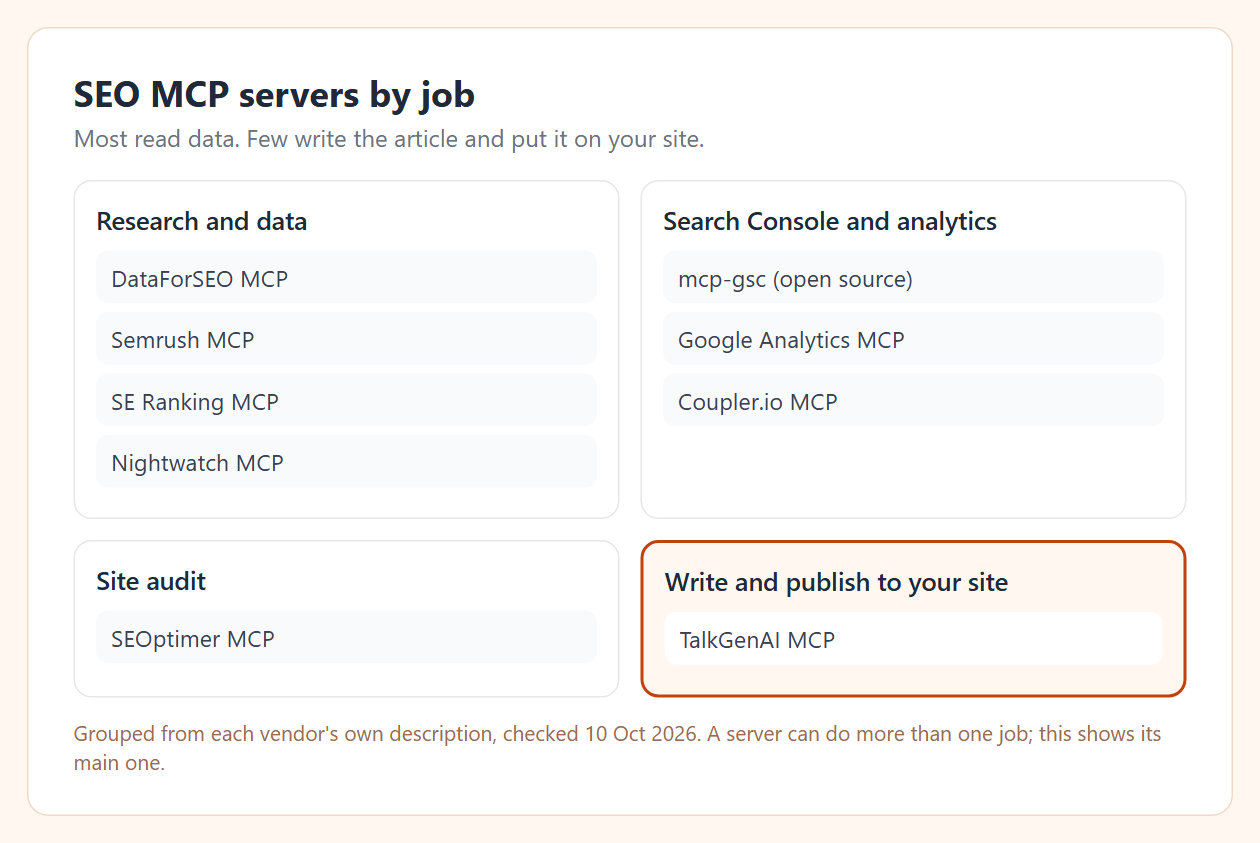
| Server | Main job | What an agent can ask it for |
|---|---|---|
| DataForSEO MCP | Research and data | SERP results, keyword metrics, backlinks, on-page checks |
| Semrush MCP | Research and data | Keyword research, competitor comparisons, keyword clusters |
| SE Ranking MCP | Research and data | Rankings, backlinks, site audits, AI search visibility |
| Nightwatch MCP | Rank tracking | Rankings, AI search visibility, technical issues, reports |
| mcp-gsc (open source) | Search Console | Search Console data, URL inspection, sitemaps |
| Google Analytics MCP | Analytics | GA4 sessions, users, engagement, top pages |
| Coupler.io MCP | Analytics | Search Console and GA4 data together, with PPC metrics |
| SEOptimer MCP | Site audit | On-demand audits, analysed in chat |
| TalkGenAI MCP | Write and publish | Articles in your brand voice, published to WordPress as drafts; also rankings and AI-assistant visits |
Which one should I start with?
| If your bottleneck is | Start with | Why |
|---|---|---|
| Knowing what people search for | A research server (DataForSEO, Semrush) | Real volumes and SERPs instead of guesses |
| Knowing what your own site already ranks for | A Search Console server, or TalkGenAI's get_rankings |
Your own data is the cheapest source of topics |
| Getting articles written and on the site | TalkGenAI | It is the step the other servers do not do |
| Technical health | An audit server | Broken pages hurt everything else |
Our own experience: the keyword data behind these guides came from DataForSEO. It showed that the topics we first planned had almost no search volume, and that "seo agent" (27,100 a month in the US) and "wordpress mcp" (880) had plenty. One cheap research call changed the whole plan; the numbers are in our SEO for SaaS guide.
How do a research server and a publishing server work together?
Connect both to the same agent (Claude Code, Claude Desktop, Cursor). The agent then chains them in one conversation:
1. Research server: "volume and difficulty for these 30 keywords"
2. You: pick 3 with real volume and low difficulty
3. TalkGenAI: get_company_brain -> generate_article (x3) -> publish_article as drafts
4. A month later, TalkGenAI: get_rankings + get_report to see what worked
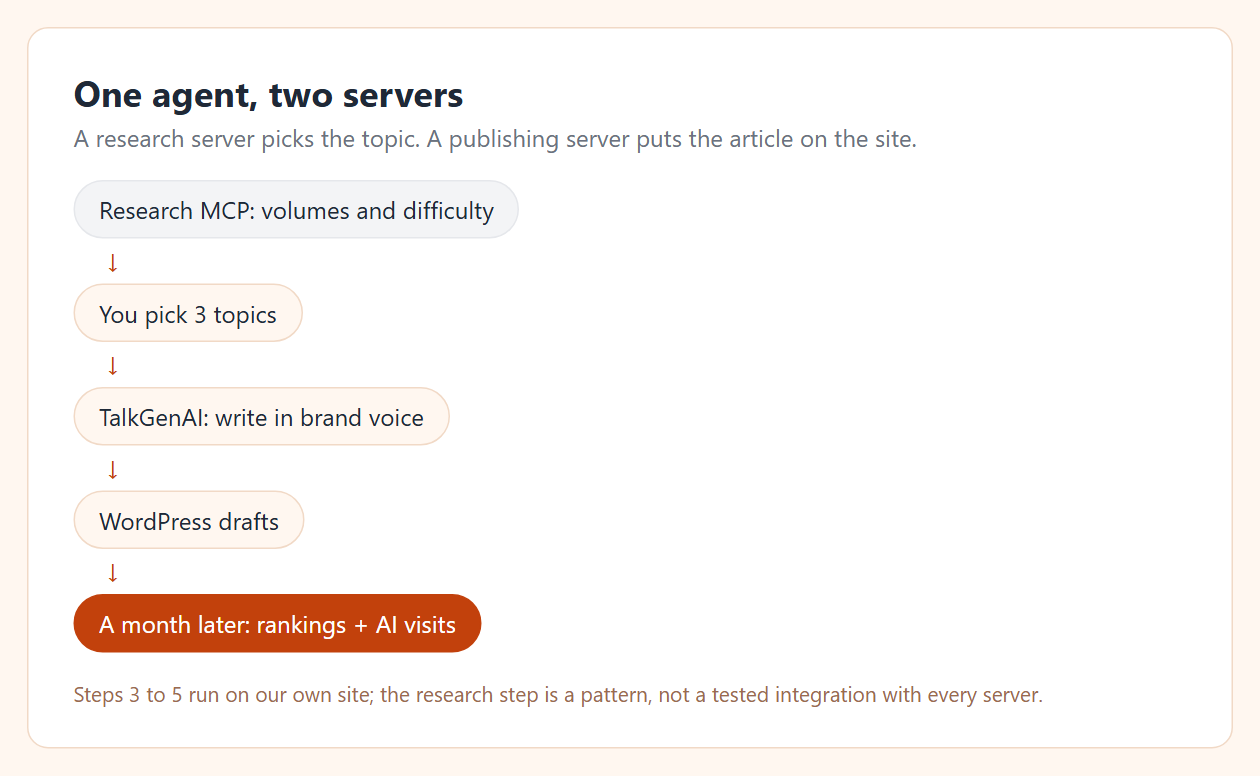
We have run step 3 and step 4 on our own site; the transcripts are in the WordPress MCP guide and the Search Console guide. We have not tested every research server in this list with TalkGenAI, so treat the chain as a pattern, not a certified integration.
What should I check before connecting a server?
- Authentication. Some take an API key. Some need you to create a Google Cloud OAuth client or a service account. TalkGenAI uses an agent key with scopes (articles, publish, reddit); see Connect your AI agent.
- What it can change. A read-only server is low risk. A server that publishes should save drafts by default. TalkGenAI does, and can block live publishing by agents entirely (Publish safely).
- What it costs per call. Research APIs often charge per request; TalkGenAI charges credits only for writing (5 per article, 8 with an image) and nothing for reading or publishing.
If you use Claude, how to use Claude for SEO has prompts that combine data and writing.
Try it in 5 minutes
Get a free agent key at app.talkgen.ai/connect-agent, add the TalkGenAI server next to your research server, and ask your agent: "Use my keyword tool to find one low-difficulty question in my niche, then write it with TalkGenAI and save a draft."
Last updated: 2026-10-10